Walnut Wood Carving
Walnut Wood Carving
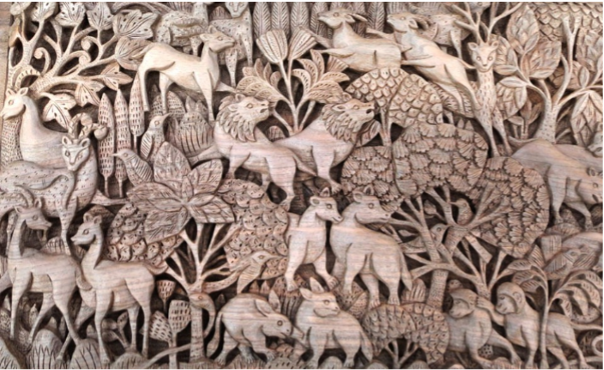
Kashmiri walnut wood carving is an intricate hand-carving craft known for its delicate motifs and unique styles like undercut, lattice work, deep carving, semi carving, and shallow carving. This centuries-old tradition reflects the region's flora, fauna, and cultural heritage. Practiced by skilled Muslim artisans in Srinagar, the craft produces decorative and utilitarian items like furniture, panels, and utensils, blending traditional craftsmanship with natural walnut wood tones.
The walnut wood carving of Kashmir employs a process of hand carving done very carefully and delicately in various styles by means of varied tools, fabricated locally depicting forms and motifs that have evolved over a period of centuries.
The process is representative of local tradition of carving, evolved from stone and transmitted later on through the medium of wood representing various facets of carving; from flat to deep relief that employs a subtle three-dimensional effect.
The carving employs a host of motifs that depict the varied flora and fauna of the region in a highly stylized manner also reflective of other associated Kashmiri handicrafts.
The desired effect and craftsmanship are achieved by the master craftsman (wasta or naqash) through calculated measured strokes for chipping, carving and rounding of the surface. The entire process is highly representative of the art of stone sculpture (shilpi) though on a more miniaturized scale.
The Kashmiri walnut wood craftsman rejoices in carving intricate and varied designs based on lively natural forms. Thus, elaborate and intricate carvings form the essentials of what is termed as good quality wood carving. This tendency or rather fascination for detail seems to have developed in the latter part of the 19th Century under European influences when the bold and effective woodcarving of yesteryears was replaced by a highly intricate process of undercutting in the 19th Century.
In today’s contemporary market, Kashmiri walnut woodcarving is recognizable because of colour and tone of the material (walnut) and its combination with local craftsmanship depicting certain established motifs in a highly intricate and miniaturized form in the traditional established styles. The Kashmir walnut woodcarving is practiced in the five main styles:
- Undercut (Khokerdar): This type of carving is highly reflective of traditional stone carving involved in the making of sculptures. This carving usually comprises multi-layers that can exceed upto seven (satnarey). The overall effect tends towards three-dimensional depiction of various motifs. Edges tend to be rounded off. Straight, sharp edges are usually avoided. This type of carving is usually carried out in panels and is a favorite with many established craftsmen (wastas). The scenes mostly depicted are complex arrangements generally associated with jungle kaam.
- Open or Lattice Work (Jaladhar, Shabokdhar): This type of carving is a favorite with artisans working in screens and employs beautiful see through Jalli work. Chinar leave motifs are also employed especially in items of furniture like the back of chair. These works are also known as cut work or see through.
- Deep Carving (Vaboraveth): This work is also known as raised work and the designs mostly employed in this form of carving comprises dragon or lotus motif.
- Semi Carving or Engraved Carving (Padri): Usually this type of work comprises thin panels along the rim of the surface with perhaps a central motif.
- Shallow or Plain Carving (Sadikaam) This type of carving is normally employed all over a flat surface.
The Kashmiri walnut woodcarving is largely devoid of geometrical patterns which are basically associated with khatamband (fir wood ceilings) and pinjarikari (wooden lattice work screens).
The walnut wood carving industry is one of the few traditional crafts of Kashmir that is totally devoid of any women participation, in any of the phases or stages of production.
The manufacturing of walnut wood carved goods has evolved into a highly evolved craft with streamlined stages of production.
The walnut wood products involve the manufacture of a variety of articles both decorative as well as utilitarian, ranging from furniture items to pure bowls, spoons, forks, panels etc. Though the industry is, to a large extent, limited to production of items that were being made in the last century; yet it still commands a highly profitable market.
During the Mughal times, inlay work (metal) in walnut wood was also widespread; but the art seems to have died down over the centuries. The walnut wood industry apparently suffered a decline during the Afghan and Sikh period before staging a revival during Dogra rule, when articles of furniture especially chairs and tables were manufactured especially for European markets.
Walnut wood carving is limited within the Muslim Community of Kashmir and is largely practised in Srinagar city.
Comments 0
Most Read
Recommended Post


Leave a Comment