Paper Machie
Paper Machie
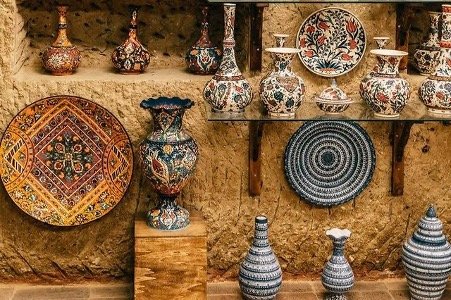
Papier Mâché is a traditional Kashmiri art involving intricate freehand designs on hardened paper, influenced by the 15th-century ruler Zain-ul-Abidin. The craft, known for items like pen cases and jewellery boxes, consists of Sakht-Sazi (making) and Naqashi (painting).
Derived from the French word, meaning ‘chewed paper’, Papier Mâché is the art of creating intricate designs on a piece of hard chewed paper with ink-filled Kalams with smooth tips. Historical studies suggest Zain-ul-Abidin had studied these arts in Samarqand in the fifteenth century.
With his accession to the throne, he invited competent teachers and craftsmen from there to train his subjects in these arts. The craft has been primarily pursued by the Shia Muslims.
“The skill shown by the Naqqash (designer)”, recorded Lawrence, “in sketching and designing is remarkable”. The industry reached its apogee during the Mughal rule when the products of the Papier Mâché art like pen cases, jewellery boxes, book-ends, etc, were in great demand in Delhi and other provincial capitals.
“The people of Kashmir write chiefly on Tuz which is the bark of a tree, worked into sheets with some rude art and which keeps for years. It was in great demand in India for writing purposes and for those who wished to impart dignity to their correspondence,” Mughal historian Abul Fazl has recorded. “Besides, Bhojpatra, the rag-paper of Kashmir was also in great demand in India. The Kashmiri rag-paper possessed a special quality that once the ink had been washed off, it could be reused for writing purposes. The best quality paper was made from rags, hemp fibre and silk and a large quantity of paper was obtained by pounding these materials. Besides paper, the Papier Mâché work also received huge patronage in the Mughal court.”
The popular designs of Papier Mâché objects include Hazara (a thousand flowers) and Gul-I-Ander-Gul (flower within the flower and the birds in foliage). The Sabzkar (foliage design) was selected by Aurangzeb. This design was highly polished with gold by which it created an alluring or fascinating depth. (Handicrafts and Kashmiri artisans during the Mughal Period, Sameer Sofi.)
The Papier-Machie work is known as Kar-i-Kalamdan because the best Papier-Machie articles of the medieval period were the pen-cases (kalamdan). Apart from pen-cases, tables, cabinets and trays were also made. Huge quantities with different colours of Papier Mâché articles like Kalamdans were manufactured from pulp paper decorated with floral motifs. (Walter Lawrence, The Valley of Kashmir and Culture and Political History of Kashmir, PNK Bamzai Volume I.)
During the eighteenth century, shawls were sent to France in Papier Mâché boxes which were separately sold there at high prices. (Handicrafts and Kashmiri artisans during the Mughal Period, Sameer Sofi.)
The Papier Mâché industry was in a flourishing condition during Kashmir’s Sikh era. Pen cases of several varieties were manufactured. Shields, bows and arrows with case, and combs were also made. Every Pandit in former times carried a pen case in the girdle bound over his Pheran or garment, or under his armpit, wherever he went.
The style of painting on these Papier Mâché articles was sometimes applied to palanquins, to the walls and ceilings of rooms. During the Sikh rule of Kashmir, the manufacture of paper was carried on very largely near Vicharnag, Srinagar. A good quantity of paper was exported to the Punjab. The Sikh aristocracy had palaces to live in, which contained very costly pieces of furniture like carpets, wall hangings, Papier Mâché articles, etc. A wealthy Karkhandar used to feed 200 poor people every day.
Papier Mâché making involves two main groups of artists: Sakhtasaz (craftsmen who create the base structure) and Naqqashi (artists who draw designs and polish the craft). The motifs used in Papier Mâché reflect a wide range of themes, including historical events, religious stories, poetic fantasies, and cultural symbols. These motifs serve as visual markers of the community’s collective memory, identity, and political history. The incorporation of various designs from different craft forms underscores the fluid exchange of artistic ideas within Kashmiri handicrafts.
These designs are very intricate, and the drawing is all freehand, for the workmen do not possess mathematical instruments. The skill shown by Nakash in sketching and designing is remarkable.
The technology of Papier Mâché in Kashmir is divided into two processes: making the object (Sakht-Sazi) and painting the surface (Naqashi). Sakhtsazi is derived from the Persian word Sakht meaning basic and Sazi meaning the act of making
Comments 0
Most Read
Recommended Post

Leave a Comment